In This Guide
- The Building Blocks: What You're Actually Looking At
- The Toolbox: Indicators and Oscillators
- The Patterns: The Market's Body Language
- Building a Practical Framework: How to Actually Use This Stuff
- The Uncomfortable Truths: Where Technical Analysis Fails
- Common Questions (The Stuff You Actually Google)
- Pulling It All Together: Mindset Over Magic
Let's be honest. You've probably seen those fancy charts with colorful lines zigzagging all over the place, promising to reveal where a stock or crypto is headed next. Maybe you've felt that twinge of curiosity—or skepticism. Is this technical analysis stuff real, or just financial astrology for people who own too many monitors?
I wondered the same thing when I first started. I remember staring at a chart of Apple stock, trying to see the "head and shoulders" pattern everyone talked about. All I saw was a squiggly line. It was frustrating. But over time, pieces started to click. I began to see that technical analysis isn't about predicting the future with certainty. It's more like learning to read the mood of a crowd. You're looking at the collective history of fear, greed, hope, and regret—all printed right there on the chart in the form of price and volume.
So, what exactly is it? In simple terms, technical analysis (often just called TA) is a method of evaluating securities by analyzing statistics generated by market activity. It focuses on price, volume, and open interest. The core idea, which comes from the Dow Theory, is that all known information is already reflected in the price. Therefore, by studying price action, you're studying the combined psychology of all market participants.
It's different from fundamental analysis, which looks at a company's financial health, management, and industry. A fundamental analyst buys a piece of a business. A technical analyst buys a piece of a trend. Both have their place, but they speak different languages.
The Building Blocks: What You're Actually Looking At
Before you can run, you have to know what the tools are. Technical analysis rests on a few core concepts that make up its vocabulary.
Price Charts: Your Main Canvas
This is where it all happens. The most common types are:
- Line Charts: The simplest. Just connects closing prices over time. Good for a clean view of the overall trend, but it hides a lot of intra-period drama.
- Bar Charts: For each period (a day, an hour), a vertical line shows the high and low. A little notch on the left marks the open, and on the right marks the close. Suddenly, you see the battle between buyers and sellers within that timeframe.
- Candlestick Charts: My personal favorite, and the most popular. Originating from Japan, these give the same info as a bar chart (open, high, low, close) but in a more visual way. The "body" is thick, colored to show if the close was above (often green/white) or below (often red/black) the open. The thin "wicks" show the highs and lows. A single candle tells a story of pressure and rejection.
Choosing a timeframe is crucial. A day trader might use a 5-minute chart. A long-term investor might look at weekly or monthly charts. The same stock can look like a raging bull on a 5-minute chart and a sleepy sideways mess on a weekly chart. Which one is "right"? It depends entirely on your goals.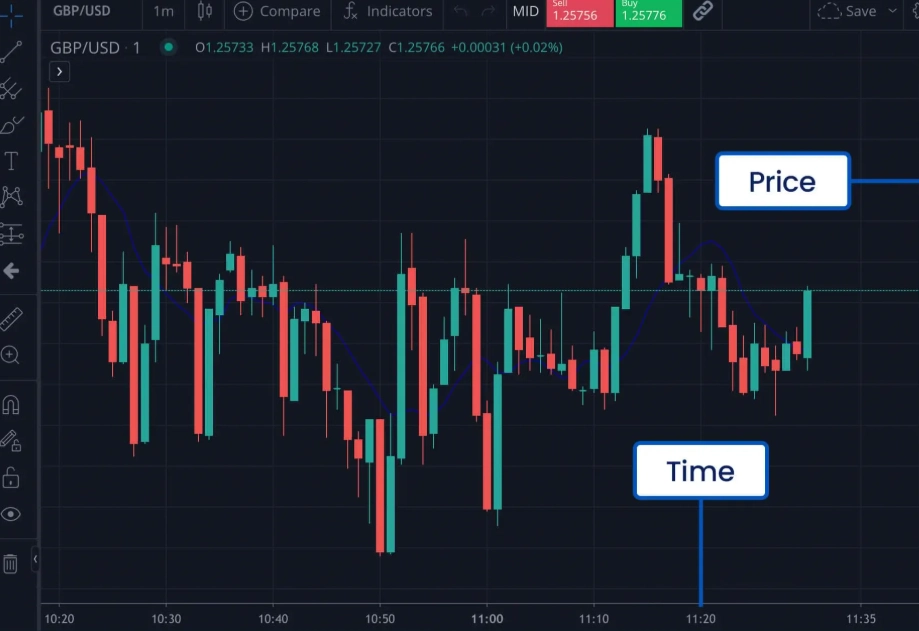
Support and Resistance: The Market's Floor and Ceiling
This is arguably the most important concept in all of technical analysis. Think of support as a price floor where buying interest tends to be strong enough to overcome selling pressure. It's a level where the price has historically had trouble falling below. Resistance is the opposite—a price ceiling where selling pressure overcomes buying pressure, stopping the advance.
Why do they exist? Psychology. At a previous high, people who bought then and saw the price fall are often waiting to "break even" and sell. That creates supply (resistance). At a previous low, people who missed the buy or see a bargain step in, creating demand (support).
And when a resistance level is broken, it often flips and becomes new support. The same happens in reverse for broken support becoming resistance. It's like the market's memory in action.
Trend: Your Best Friend in the Market
The old saying is "the trend is your friend." It's cliché because it's true. Fighting a strong trend is a great way to lose money. A trend is simply the general direction the price is moving.
- Uptrend: A series of higher highs and higher lows. The overall trajectory is up.
- Downtrend: A series of lower highs and lower lows. The path of least resistance is down.
- Sideways/Ranging Trend: Price oscillates between clear support and resistance levels with no clear directional bias. This is also called consolidation.
Identifying the trend should be step one in any analysis. Most indicators and patterns work better when they align with the prevailing trend. Buying a "bullish" pattern in a strong downtrend is a much riskier bet than buying the same pattern in an uptrend.
The Toolbox: Indicators and Oscillators
This is where things get colorful. Indicators are mathematical calculations based on price and/or volume, plotted on or below the chart to give additional insights. They fall into a few main categories.
Trend-Following Indicators
These are lagging indicators. They smooth out price data to confirm a trend that's already in place, not predict a new one.
- Moving Averages (MA): The workhorse. It shows the average price over a specific period. A 50-day MA shows the average closing price over the last 50 days. It acts as a dynamic support/resistance line. Traders watch for the price crossing above or below a MA, or for shorter-term MAs (like the 20-day) crossing longer-term ones (like the 50-day)—a "golden cross" or "death cross."
- MACD (Moving Average Convergence Divergence): This shows the relationship between two MAs. It has a signal line, and when the MACD line crosses above the signal line, it can be a buy signal (and vice versa). It also has a histogram that shows the momentum behind the move.
Momentum Oscillators
These are leading or coincident indicators. They help gauge the speed and strength of a price move and can signal overbought or oversold conditions.
| Indicator | What It Measures | Common Use & Interpretation | My Take (The Good & The Annoying) |
|---|---|---|---|
| RSI (Relative Strength Index) | The magnitude of recent price changes to evaluate overbought/oversold conditions. Range: 0 to 100. | Above 70 = potentially overbought (may pull back). Below 30 = potentially oversold (may bounce). Divergence (price makes new high, RSI doesn't) can signal weakening momentum. | Incredibly popular, but dangerous if used alone. In a strong trend, RSI can stay overbought/oversold for ages. Best used to spot potential reversals in ranging markets. |
| Stochastic Oscillator | Compares a closing price to its price range over a period. Range: 0 to 100. | Similar overbought/oversold readings as RSI. Has a %K and %D line; a crossover can signal a move. Looks at where price closed relative to its recent range. | More sensitive than RSI, so it gives more signals—both good and bad (more false positives). Can be noisy on shorter timeframes. |
| Williams %R | Similar to Stochastic, but scaled from -0 to -100. | Readings above -20 = overbought. Readings below -80 = oversold. | A simpler cousin to Stochastic. I find it less commonly used now, but the principles are the same. |
Volume Indicators
Volume is the fuel behind the move. A price change on high volume is considered more significant than one on low volume. It confirms the strength of a breakout or a trend.
- On-Balance Volume (OBV): Adds volume on up days and subtracts it on down days, creating a running total. The idea is that volume leads price. If OBV is making new highs while price isn't, it suggests accumulation (smart money buying).
- Volume Profile: This shows how much volume traded at specific price levels over a time period. It helps identify high-volume nodes (strong support/resistance) and low-volume nodes (areas where price can move quickly).
Personally, I think volume is underrated by beginners. Price can lie, but volume is much harder to fake consistently. A breakout from a key level on puny volume? I'm very skeptical of that move holding.
The Patterns: The Market's Body Language
Charts form patterns that reflect recurring psychological battles. They fall into two groups: Reversal Patterns (signaling a trend change) and Continuation Patterns (signaling a pause before the trend resumes).
Common Reversal Patterns
- Head and Shoulders (Top): A peak (left shoulder), a higher peak (head), then a lower peak (right shoulder). The "neckline" is support. A break below it signals a potential trend reversal from up to down. The inverse pattern exists for bottoms.
- Double Top/Bottom: Price tests a resistance level twice (double top) or a support level twice (double bottom) and fails to break through. The break of the swing low between the two tops confirms the double top. Looks like an "M" or a "W."
Common Continuation Patterns
- Triangles (Ascending, Descending, Symmetrical): Price coils into a tighter and tighter range. A breakout from the triangle typically continues the prior trend. Symmetrical triangles are neutral; the breakout direction decides.
- Flags and Pennants: Sharp, strong moves (the "flagpole") followed by a small, sloped consolidation (the "flag") or a small symmetrical triangle (the "pennant"). These are short-term pauses. A breakout usually resumes the initial strong move.
Here's the thing about patterns: they are not guarantees. They are probabilities. A head and shoulders pattern might fail and the trend might just keep going (this is called a "failed pattern" and can lead to a powerful move in the opposite direction). You need confirmation, like a strong close beyond the neckline on higher volume.
Building a Practical Framework: How to Actually Use This Stuff
Okay, you know the pieces. How do you put them together without getting overwhelmed? You need a process, a checklist. Throwing darts at indicators won't work.
Here's a simplified, multi-timeframe framework I might use for a swing trade (holding for days to weeks):
- Identify the Macro Trend (Weekly/Daily Chart): Is the asset in a clear uptrend, downtrend, or range? This sets your overall bias. Only look for buys in uptrends or ranges, and sells/shorts in downtrends or ranges. Don't fight the tape.
- Find a Key Level (Daily/4-Hour Chart): Zoom in. Where is major support or resistance? Is price approaching it? These are the zones where interesting things happen.
- Look for a Confluence Signal (4-Hour/1-Hour Chart): This is the trigger. Don't rely on one thing. Look for 2 or 3 pieces of evidence aligning. For example: Price pulls back to a rising 50-day MA (support) AND the RSI dips near 40 (not oversold, but cooling off) AND a bullish candlestick pattern forms (like a hammer or bullish engulfing) right at that MA support zone. That's confluence.
- Define Your Risk IMMEDIATELY: Before you enter, know exactly where you're wrong. If you're buying at that support, your stop-loss should be just below it. This isn't optional. It's how you survive.
- Manage the Trade: Have a plan for taking profits. Maybe you sell half at a previous resistance level and trail your stop on the rest. The hardest part isn't entering, it's sitting and then exiting rationally.
This is just one approach. A day trader would use much shorter timeframes. A long-term investor might just use weekly charts and moving averages. The key is having a structured process you follow every time, so your emotions don't make the decisions.
The Uncomfortable Truths: Where Technical Analysis Fails
If I'm writing a real guide, I have to tell you the downsides. Blind faith in technical analysis is a recipe for disaster.
It's Self-Fulfilling to a Point: Because so many people watch the same levels (like the 200-day MA or a round number like $100), there can be a rush of orders there, making the level work. But this isn't magic; it's crowd psychology.
It's Terrible with Black Swan Events: A sudden earnings disaster, a geopolitical shock, a regulatory crackdown—these fundamental bombs can blow through any technical level instantly. TA assumes a constant flow of information. Sudden, massive new information breaks the model.
Analysis Paralysis is Real: You can have 10 indicators on your screen all giving different signals. More information doesn't lead to better decisions if it's conflicting noise. Keep it simple.
Past Performance... You Know the Rest: TA is based on the idea that history rhymes. But it doesn't repeat exactly. The context is always different.
That's why the best traders I know use TA not as a crystal ball, but as a risk management and probability framework. It tells them where to place bets with favorable odds and, more importantly, where to get out if they're wrong.
Common Questions (The Stuff You Actually Google)
Pulling It All Together: Mindset Over Magic
At the end of the day, technical analysis is a skill, not a secret code. It won't make you rich overnight. What it can do is provide a structured way to view the markets, define your risk, and look for repeatable scenarios where the odds might be in your favor.
The chart doesn't know the future. It just shows you what has happened. Your job is to interpret that story, place a bet with defined risk, and manage your emotions when you're right and—more importantly—when you're wrong.
Start simple. Pick one asset. Look at its long-term chart. Draw some horizontal lines at obvious highs and lows. Add a 50-period moving average. Watch how price interacts with these things for a few weeks without trading. Get a feel for it.
There's a wealth of information out there. Sites like Investopedia offer detailed, reliable definitions of every term and concept mentioned here. The Commodity Futures Trading Commission (CFTC) also publishes advisories that often discuss market analysis concepts, especially in the futures and derivatives spaces where TA is heavily used.
Remember, the goal isn't to be right on every trade. The goal is to have a positive expectancy over many trades. That comes from good risk management, patience, and a deep understanding that technical analysis is a map of past battles, not a prophecy of future wars. Use it as your map, but always keep an eye on the real-world terrain.
Good luck, and trade safe.
Reader Comments