Quick Navigation
- Why Should You Even Care About YTD?
- The Nuts and Bolts: How is YTD Actually Calculated?
- YTD in the Wild: Real-World Applications Beyond the Spreadsheet
- Conquering YTD in Excel & Google Sheets: No More Headaches
- The Limits and Pitfalls of YTD: What It Doesn't Tell You
- YTD vs. Its Cousins: MTD, QTD, and YoY
- Answering Your Burning YTD Questions (FAQ)
- Putting It All Together: Your YTD Action Plan
Hey there! Ever looked at a financial report and scratched your head at 'YTD'? Or maybe your boss asked for a YTD sales figure, and you nodded while secretly Googling it under the desk. Don't worry, you're not alone. YTD, or Year-to-Date, is one of those terms that gets thrown around a lot in business and finance, but its simplicity is often buried under layers of corporate-speak.
I remember the first time I had to calculate a YTD metric. It was for a project update, and I spent way too long second-guessing myself. Was I supposed to include today? What if the fiscal year started in July? It felt like a simple concept that shouldn't be confusing, but the context kept changing.
Let's clear that up, once and for all.
At its core, YTD means exactly what it says: a measurement of something from the start of the current year (or a specific fiscal year) right up to the present moment. It's a running total, a snapshot of performance so far. Think of it as the score in a game that's still being played.
But here's where it gets interesting—and where most quick explanations stop. The real value of understanding YTD isn't just in defining it; it's in knowing how to use it, where it trips people up, and why it's absolutely critical for making informed decisions, whether you're running a company, managing a team, or just tracking your personal budget.
Why Should You Even Care About YTD?
This isn't just accountant stuff. YTD is a practical lens for seeing your progress. Imagine driving a car but only looking at the speedometer for a single second. That's a monthly report. Looking at the YTD is like checking the trip computer—it tells you your average speed, how far you've come, and how much fuel you've used on the entire journey so far. It provides context that a single point in time simply cannot.
In business, YTD figures are the antidote to short-term noise. A bad month might look like a disaster, but a strong YTD position tells the true story of resilience. A great month might be a fluke, but a great YTD trend indicates real, sustainable growth. It smooths out the bumps and reveals the underlying trajectory.
For investors, YTD return is often the first number they check. It's a quick, standardized way to gauge how an investment has performed since January 1st, making it easy to compare different stocks, funds, or even your own portfolio against market benchmarks. You'll see it everywhere, from your brokerage statement to financial news sites.
And personally? I started tracking my own expenses on a YTD basis a few years back. Seeing the cumulative total for "coffee shops" or "online subscriptions" by October is a far more effective wake-up call than any monthly report. It's the power of compounding, but for your spending habits.
The Nuts and Bolts: How is YTD Actually Calculated?
Okay, let's get practical. The basic formula is laughably simple:
YTD Value = Sum of all values from the start of the period to the current date.
But as with many simple things, the devil is in the details. The "start of the period" is the big variable.
The Calendar Year vs. Fiscal Year Trap
This is the number one point of confusion. Most people assume YTD always means January 1st. In casual conversation, it often does. But in the professional world, it's dangerous to assume.
- Calendar Year YTD: Runs from January 1 to the current date. This is common for personal finance, taxes in many countries, and general business discussions.
- Fiscal Year (FY) YTD: Runs from the start date of a company's or organization's own financial year. A company with a fiscal year starting July 1 would have a YTD on October 31 that covers July, August, September, and October.
Always, always clarify which year you're talking about. I've been in meetings where two managers argued over declining YTD sales, only to realize one was using a calendar year and the other was using the fiscal year that started in April. The data was literally referring to different time periods. It was an embarrassing waste of time that could have been avoided with a clear definition upfront.
Government entities often have specific fiscal years. For accurate definitions and reporting standards, referring to official sources like the U.S. Securities and Exchange Commission's (SEC) resources on financial reporting can be invaluable for understanding how public companies define and report these periods.
What Are You Summing? Values vs. Metrics
YTD can apply to raw numbers or calculated metrics.
| What You're Measuring | YTD Calculation Example | Common Use Case |
|---|---|---|
| Cumulative Totals | YTD Revenue = Sum of all daily/monthly revenue since Jan 1. | Income statement, sales dashboards. |
| Average Values | YTD Average Customer Rating = Average of all monthly ratings. | Performance tracking, quality assurance. |
| Ending Balances | YTD Net Profit = Total Revenue - Total Expenses for the period. | Profit & Loss statements. |
| Returns / Growth | YTD Return = ((Current Value - Value at Year Start) / Value at Year Start) * 100. | Investment portfolios, fund performance. |
See the difference? A YTD total is additive. A YTD average or return is a derived figure based on the performance over the entire period. Knowing which one you're looking at is crucial for interpretation.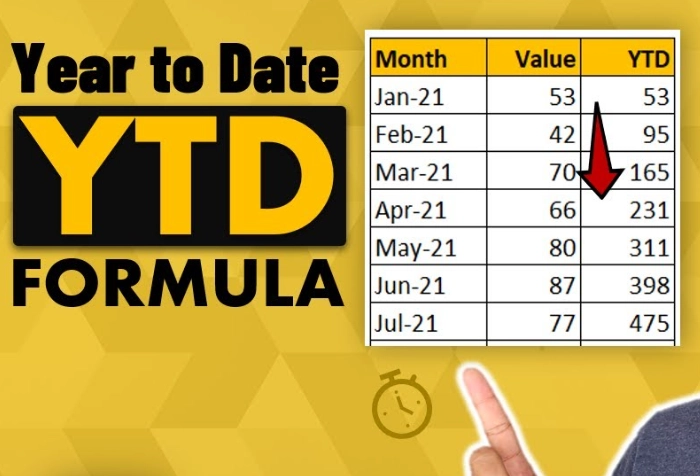
YTD in the Wild: Real-World Applications Beyond the Spreadsheet
Let's move beyond theory. Where do you actually encounter and use YTD figures?
1. In Finance & Investing (The Most Common Spot)
Open any financial website like Bloomberg or Yahoo Finance, and you'll see "YTD Return" next to every stock ticker. This single figure allows for instant comparison. Is your stock up 5% YTD while the market index is up 10%? That's a clear, contextual starting point for analysis.
For mutual funds and ETFs, the YTD performance is a key marketing and analytical tool. It answers the investor's primary question: "What has this done for me lately (this year)?" Regulators require clear presentation of this data. The methodology for calculating these returns is often detailed in fund prospectuses, which are governed by SEC rules.
2. In Business & Sales Management
This is where YTD becomes a daily management tool.
- Sales Targets: "You're at 72% of your annual quota YTD." This is infinitely more useful than "You sold X this month." It shows progress against the ultimate goal.
- Budget vs. Actual: "Our marketing spend is at 85% of the annual budget YTD, and we're only in Q3." That's a red flag that wouldn't be obvious from a monthly report.
- Operational Metrics: YTD customer complaints, YTD units produced, YTD employee turnover. These trend-spotting figures help identify chronic issues or successes.
I once managed a project where the monthly completion rate looked fine—always between 90-100%. But when I plotted the YTD completion rate, it showed a steady, gradual decline from 98% to 91%. That slow creep indicated a systemic efficiency drain we were missing month-to-month. The YTD view saved the project.
3. In Personal Finance & Budgeting
Your bank and credit card statements often provide a YTD summary for interest earned or paid. But the real power is DIY.
By tracking your own spending categories YTD, you move from reactive budgeting (“I overspent on dining out this month”) to proactive forecasting (“At my current YTD rate, I will exceed my annual dining budget by $600 by December, so I need to adjust now”). Tools like personal capital spreadsheets or budgeting apps are built for this kind of cumulative tracking.
4. In Project Management
YTD is excellent for tracking project spend (actual cost vs. budget), resource utilization (hours used YTD vs. allocated), and milestone completion. It answers the stakeholder's question: "Overall, are we on track?"
Conquering YTD in Excel & Google Sheets: No More Headaches
This is a huge pain point for people. You have a column of monthly sales, and you need a YTD running total column. How do you do it efficiently?
The most common and robust method is using the SUM function with a locked reference.
Let's say your monthly revenue is in cells B2 (January) through B13 (December). In cell C2 (your YTD column for January), you would write: =SUM($B$2:B2)
Then, you drag that formula down. For February (C3), it becomes =SUM($B$2:B3), summing Jan-Feb. For March, it sums Jan-Mar, and so on. The $ before B and 2 locks the starting point, so it always starts summing from January.
A common mistake is just adding the current month to the previous YTD cell (e.g., C3 = C2 + B3). While this works, it's fragile. If you delete a row or there's an error in one cell, the entire chain breaks. The SUM method is self-contained for each row and is much more reliable.
For more dynamic dashboards where the "current date" matters, you can get fancy with functions like TODAY(), YEARFRAC, and SUMIFS to automatically sum data from the start of the year to the current day, even as days pass. For example, to sum all expenses from a table where the date is in the current year and on or before today: =SUMIFS(ExpenseAmount, ExpenseDate, ">="&DATE(YEAR(TODAY()),1,1), ExpenseDate, ".
Microsoft's official support page for the SUMIFS function provides authoritative examples of this kind of date-based summation, which is the cornerstone of dynamic YTD calculations.
The Limits and Pitfalls of YTD: What It Doesn't Tell You
YTD is a powerful tool, but it's not a crystal ball. Relying on it blindly can lead you astray. Here's what to watch out for.
Seasonality is the Killer. This is the biggest limitation. A YTD figure for a retail business in December will look amazing because it includes the holiday shopping frenzy. A YTD for the same business in June might look weak. The YTD number doesn't account for the expected seasonal pattern within the year. You always need to compare it to a YTD figure from the prior year (YoY YTD) or a seasonal forecast to understand if performance is truly good or bad.
It's Backward-Looking. YTD tells you where you've been, not necessarily where you're going. A strong YTD doesn't guarantee a strong finish if market conditions change. It's a lagging indicator.
It Can Mask Recent Changes. If performance suddenly tanks or soars in the most recent period, a YTD figure, being an average of many months, might dilute that signal. A company with nine months of stellar sales and one month of zero sales will still have a great YTD, masking the current crisis. Always look at the YTD trend and the latest period data.
YTD vs. Its Cousins: MTD, QTD, and YoY
YTD doesn't exist in a vacuum. It's part of a family of period-to-date metrics. Knowing which one to use is key.
- MTD (Month-to-Date): From the 1st of the current month to now. Hyper-current, great for daily management. Volatile.
- QTD (Quarter-to-Date): From the start of the current financial quarter to now. Balances timeliness with a slightly longer view.
- YTD (Year-to-Date): The big-picture, strategic view of the year's progress so far.
- YoY (Year-over-Year): Compares a period (a month, a quarter, or YTD) to the exact same period in the previous year. This is YTD's best friend, as it removes seasonality. YoY YTD (comparing this year's YTD to last year's YTD) is arguably the most important business performance metric there is.
So, a complete analysis might say: "Sales are soft MTD, but QTD is meeting target, and YTD is 5% ahead of last year's YTD, which is excellent." Each metric tells a different part of the story.
Answering Your Burning YTD Questions (FAQ)
Is YTD the same as "Year-to-Date"?
Yes, 100%. YTD is just the acronym. They are used interchangeably.
How do I calculate YTD percentage?
It depends on the percentage of what. The most common is YTD achievement: (YTD Actual / Annual Target) * 100. For growth, it's: ((Current YTD - Previous YTD) / Previous YTD) * 100.
Why does the YTD figure on my pay stub sometimes look wrong?
Payroll YTD includes everything taxable: base pay, overtime, bonuses, taxable benefits. It's the running total your employer reports to the tax authorities. A discrepancy often comes from forgetting about a one-time bonus or a benefit that was taxed. Always check your last pay stub of the previous year to confirm the starting point was zeroed out correctly.
In investing, is YTD return the same as my total profit?
Not exactly. YTD return is a percentage based on the value at the year's start. Your profit/loss is the dollar amount. Also, YTD return typically assumes dividends are reinvested, while your simple profit calculation might not. Always check the calculation methodology.
What's a "good" YTD return?
There's no single answer. It depends on the asset class (stocks vs. bonds), risk level, and the market environment. A good benchmark is to compare your investment's YTD return to a relevant index (like the S&P 500 for US stocks). Beating the index YTD is often considered "good" in relative terms. The Financial Industry Regulatory Authority (FINRA) provides investor education tools that emphasize the importance of benchmark-relative comparison, rather than chasing arbitrary percentage targets.
Putting It All Together: Your YTD Action Plan
So, what should you do with all this?
- Context is King: Never look at a YTD number in isolation. Always ask: "YTD compared to what?" (Last year? The budget? The target?).
- Clarify the Year: In any professional setting, explicitly state "Calendar YTD" or "Fiscal YTD (FY24)." Make it a habit.
- Use the Right Tool in Sheets/Excel: Master the
SUM($B$2:B2)pattern for robust running totals. It will save you time and errors. - Pair YTD with YoY: To neutralize seasonality, make YoY YTD your go-to analysis for spotting real trends.
- Start a Personal YTD Tracker: Pick one thing—savings, reading books, miles run—and track it on a YTD spreadsheet. You'll instantly feel the motivational pull of that cumulative number growing.
YTD isn't magic. It's just a way of organizing time and numbers to reveal the story underneath the daily chaos. Once you get comfortable with it, you'll start seeing opportunities and problems much earlier. You'll move from reacting to data to anticipating outcomes.
And honestly, that's a pretty good place to be.
Reader Comments