Quick Navigation
- Why Bother with Per Capita? It’s All About Fair Comparison
- How Do You Actually Calculate Per Capita? It’s Shockingly Simple
- The Big Caveat: What Per Capita Does NOT Tell You
- Per Capita vs. Median: Which One Should You Trust More?
- Putting It Into Practice: How to Use Per Capita Data Wisely
- Common Questions About “What Does Per Capita Mean”
- Final Thoughts: Making Per Capita Work For You
So you’ve come across this term, probably in a news article or a report, and you’re wondering, what does per capita mean, really? It’s one of those phrases that gets thrown around a lot, especially when talking about money, income, or resources of a country. I remember the first time I saw it, I just glossed over it, assuming it was some complex economist jargon. Turns out, it’s a brilliantly simple concept, but misunderstanding it can lead you to completely wrong conclusions about the world.
Let’s cut through the noise. In its most basic sense, “per capita” is a Latin term that means “per head” or “for each person.” When you see a statistic labeled “per capita,” it’s telling you that a total amount has been divided equally among every single individual in a defined group, usually a country’s population. It’s a way to standardize data so you can make fair comparisons. Think about it this way: knowing that Country A produces more wheat in total than Country B doesn’t tell you much if Country A has ten times the population. The per capita figure levels that playing field.
The Core Idea: If a news headline says “GDP per capita,” it’s answering the question: “If the total economic output of this country were split evenly among every man, woman, and child, how much would each person get?” It’s a theoretical average, a powerful tool for comparison, but it’s crucial to remember it’s an average. It doesn’t mean everyone actually has that amount.
Why Bother with Per Capita? It’s All About Fair Comparison
Let’s get practical. Why should you care about what per capita means? Because raw totals can be incredibly misleading. I once read a list of the “richest countries” based on total GDP. China and India were near the top, which makes sense—they’re massive economic powerhouses. But if you look at GDP per capita, the story flips dramatically. Smaller countries with highly developed economies, like Luxembourg or Switzerland, shoot to the top. That’s a more meaningful measure of average individual economic well-being within a country’s borders.
Here’s a simple table to show you the stark difference. Look at how the ranking changes when you switch from total economic size to the per-person measure.
| Country | Total GDP (Nominal, 2023 est.) | GDP Per Capita (Nominal, 2023 est.) | What the Per Capita Figure Tells Us |
|---|---|---|---|
| Luxembourg | ~$86 billion | ~$135,000 | A very high standard of living on average for its small population. |
| India | ~$3.7 trillion | ~$2,600 | Despite a huge total economy, the average income is much lower due to its vast population. |
| United States | ~$26.9 trillion | ~$80,000 | A large total economy combined with a high average output per person. |
See the shift? India’s total GDP is enormous, but its GDP per capita tells a story of a developing economy with a lot of people. This is the primary power of understanding what does per capita mean—it prevents you from comparing apples and oranges. You wouldn’t judge a family of two’s wealth by the same total income as a family of ten, right? Same principle for countries, states, or cities.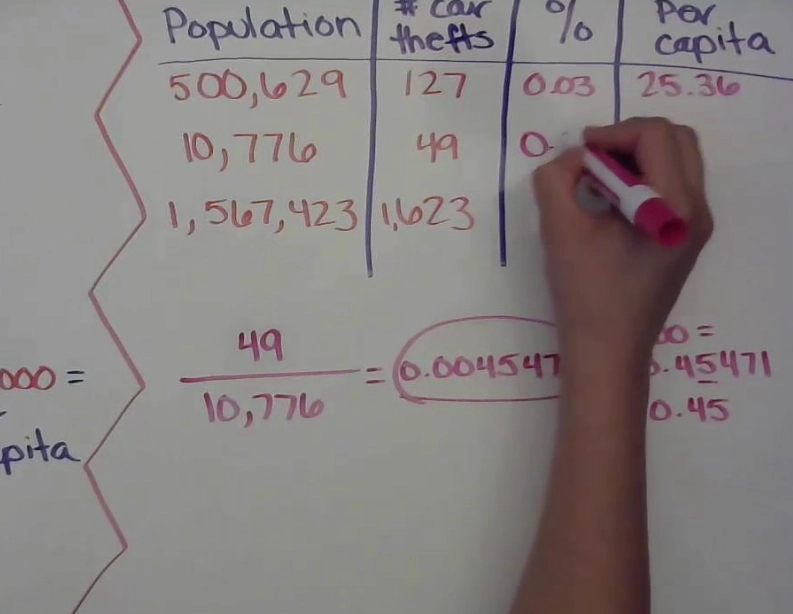
How Do You Actually Calculate Per Capita? It’s Shockingly Simple
The formula is so straightforward it’s almost anticlimactic. Here’s the universal per capita formula:
Per Capita = (Total Amount of a Resource or Measurement) / (Total Population of the Group)
That’s it. You take the big number (like a country’s total income, carbon emissions, or number of hospitals) and you divide it by the number of people. The result is the amount per person. For example, if a town of 10,000 people has a total budget of $50 million, its budget per capita is $5,000. This means, on average, $5,000 of public spending is allocated for each resident. It’s a useful way for the town council to argue for more funds compared to a wealthier but smaller neighboring town.
Where You’ll See Per Capita Data in the Wild
Once you start looking, you’ll see per capita everywhere. It’s the go-to metric for making comparisons fair. Here are the most common places you’ll bump into it:
- Economics: GDP per capita, GNI (Gross National Income) per capita, income per capita, debt per capita. This is the big one. Organizations like the World Bank publish mountains of this data, and it’s fundamental for understanding economic development.
- Healthcare & Social Indicators: Doctors per capita, hospital beds per capita, crime rates per capita (e.g., murders per 100,000 people), internet users per capita. This tells you about access and prevalence of services or issues.
- Environmental Studies: Carbon emissions per capita, energy consumption per capita, water usage per capita. A country like China has the world’s highest total CO2 emissions, but on a per capita basis, several countries like the United States, Canada, and Australia have historically been higher. It frames the responsibility debate differently.
- Business & Market Research: Spending per capita, smartphone ownership per capita. Companies use this to gauge market saturation and potential in different regions.

The Big Caveat: What Per Capita Does NOT Tell You
Now, here’s where a lot of people get tripped up, and it’s the most important part of this whole discussion. Understanding what per capita means also means understanding its limitations. The biggest one? It assumes perfect, equal distribution, which almost never happens in reality.
Let’s say a country has a GDP per capita of $50,000. Your brain might picture a nation where every person earns around $50,000 a year. That’s a fantasy. In reality, that $50,000 average could be the result of a few billionaires earning hundreds of millions and millions of people earning far less. The average is pulled up by the extreme highs.
I find this to be the most frustrating part of using per capita data. It can paint a rosy picture of a place that has severe inequality. That’s why savvy analysts always look at per capita figures alongside measures of income distribution, like the Gini coefficient. The U.S. Census Bureau, for instance, provides deep dives into median household income and income distribution, which tell a more nuanced story than per capita income alone.
Personal Take: I was once researching potential cities to live in and was dazzled by a city’s high average (per capita) income. It wasn’t until I dug deeper and saw the median income and housing cost data that I realized the “average” was skewed by a few ultra-wealthy neighborhoods, and the reality for most people was a brutal cost-of-living squeeze. Per capita was a starting point, not the finish line.
So, when you see a per capita stat, always ask: “Is this likely to be evenly distributed?” For things like national defense spending or pollution, maybe the average is a decent proxy for shared burden. For income and wealth? Almost never.
Per Capita vs. Median: Which One Should You Trust More?
This is the natural follow-up question. If per capita (the mean average) can be so misleading, what’s the alternative? Often, it’s the median.
- Per Capita (Mean) Income: Total income of all people divided by the number of people. Easily skewed by extremes.
- Median Income: The middle point. Line up every person from poorest to richest, and the person in the exact middle has the median income. Half earn more, half earn less.
For understanding the “typical” person’s experience, the median is often more reliable. If a small town has one billionaire and 999 people with modest incomes, the per capita income will be in the millions, making the town look absurdly rich. The median income will reflect the reality of the 999. The UN Human Development Index (HDI) actually uses GNI per capita but adjusts it for inequality to get a clearer picture of real living standards.
When Per Capita is Still the Right Tool
Don’t throw the baby out with the bathwater, though. Per capita is still king for specific types of comparisons, especially when you’re dealing with national resources, environmental impact, or infrastructure.
Questions like “Which country uses more resources per person?” or “How does healthcare funding per person compare across states?” are perfectly suited for per capita analysis. It’s about the appropriate tool for the job. For aggregate economic output comparison between nations of different sizes, GDP per capita remains indispensable, even with its inequality blind spot.
Putting It Into Practice: How to Use Per Capita Data Wisely
Okay, you get the concept and the pitfalls. How do you actually use this knowledge? Let’s say you’re reading a news article that claims, “Country X has a dangerous level of debt.” Your new mental checklist should be:
- Is it total debt or debt per capita? A large total debt might be manageable for a large, rich country (like the U.S.), while a smaller total debt could crush a tiny, poor nation. Debt-to-GDP ratio is actually a better metric here, but per capita debt is a good first reality check.
- What’s the context of the comparison? Are they comparing Country X’s total debt to Country Y’s total debt without mentioning population? That’s a red flag. A fair comparison must account for population size.
- Can I find the per capita number myself? Often, you can. If the article says “National debt is $10 trillion” and you know the population is roughly 300 million, a quick division ($10T / 300M) gives you a debt of about $33,000 per person. That’s a more tangible, comparable figure.
This skill turns you from a passive consumer of information into an active, critical thinker. You start to see when statistics are being used to inform and when they’re being used to persuade (or mislead).
Common Questions About “What Does Per Capita Mean”
Does “per capita” mean “per person”?
Yes, absolutely. That’s the direct translation from Latin. They are interchangeable in most contexts. If you see “income per person,” it’s the same calculation as income per capita.
Is per capita the same as per household?
No, and this is a crucial distinction. Per capita is for each individual. Per household is for each family or housing unit. A statistic like “income per household” will be much higher than “income per capita” because one household often contains multiple income-earning people. Always check the unit!
How is GDP per capita different from GDP?
GDP (Gross Domestic Product) is the total monetary value of all finished goods and services produced within a country’s borders in a year. It’s the raw size of the economic pie. GDP per capita is that total divided by the population—it’s the theoretical size of each person’s slice if the pie were divided evenly. One measures scale, the other measures average prosperity.
Why do some per capita stats use “per 100,000 people”?
Great observation. For rare events (like certain diseases or specific violent crimes), the number per capita would be a very small decimal (e.g., 0.0002). That’s hard to grasp. So, statisticians scale it up to “per 100,000 people” to get a more manageable whole number (e.g., 20 cases per 100,000 people). The principle is identical—it’s just a different scaling factor for readability.
Final Thoughts: Making Per Capita Work For You
So, what does per capita mean for you, the reader? It’s a key to unlocking more accurate understanding of the world. It’s a filter you can apply to news, reports, and even business proposals.
The next time you see a bold claim based on a big total number, pause. Ask yourself, “What would this look like on a per capita basis?” Do that quick mental check—divide by the population. It takes seconds but can completely change your perspective.
Remember, it’s a tool for fair comparison, not a perfect description of reality. Pair it with median data and inequality measures when you really want to understand how people live. Used wisely, understanding what per capita means makes you a more informed citizen, a savvier investor, and a harder person to fool with misleading statistics. And in a world flooded with data, that’s a pretty powerful skill to have.
Reader Comments