Let's cut to the chase. You've probably heard of the law of large numbers. It sounds like a dry math concept, something for statisticians in lab coats. But I'm here to tell you it's probably the most practical, misunderstood, and powerful idea you can use to make better decisions with your money, your business, and even your life. It's the reason casinos don't worry about a single big winner, why insurance is a multi-trillion dollar industry, and why your gut feeling about a "hot streak" is almost always wrong. Forget the textbook definition for a minute. At its core, the law of large numbers is about one thing: predictability emerges from chaos, but only when you have enough data. Without it, you're just guessing.
What You'll Discover Today
- What Is the Law of Large Numbers (And What It's Not)?
- How Does the Law of Large Numbers Actually Work?
- Real-World Applications: From Casinos to Your Portfolio
- The 3 Most Dangerous Misconceptions About the Law of Large Numbers
- How to Apply the Law of Large Numbers to Your Decisions
- Your Questions, Answered
What Is the Law of Large Numbers (And What It's Not)?
In simple terms, the law of large numbers states that as you increase the number of trials or observations in a random experiment, the average of the results will get closer and closer to the expected value. Flip a fair coin 10 times, you might get 7 heads. That's a 70% rate, far from the expected 50%. Flip it 10,000 times, and I'll bet my lunch the percentage of heads will be so close to 50% it's uncanny.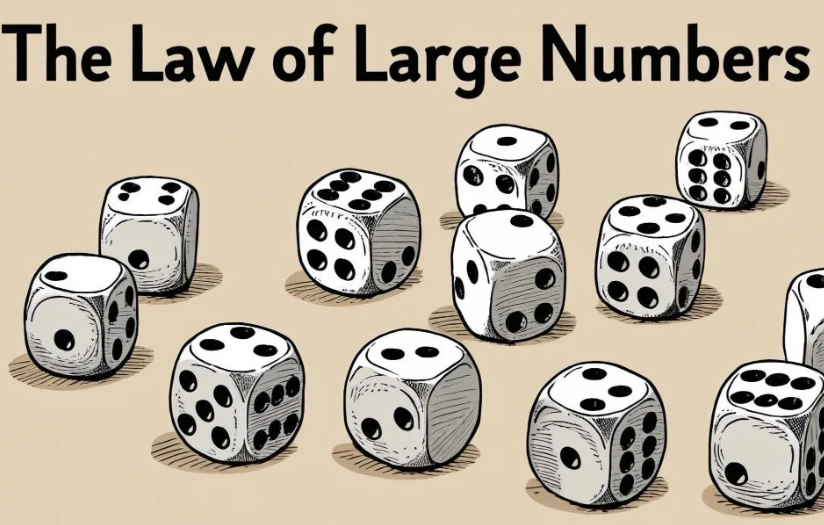
Here's the crucial part everyone misses: it makes no promises about the next single event. This is where people get tripped up. After 9 heads in a row, the coin doesn't "owe" you a tail to balance out. The 10th flip is still a 50/50 shot. The law works on the aggregate, the long-run average, not on correcting short-term deviations. This confusion is the root of the gambler's fallacy, and it costs people real money.
How Does the Law of Large Numbers Actually Work?
Let's break it down without the equations. Imagine you run a small e-commerce store selling artisanal coffee. Your conversion rate (the percentage of visitors who buy) is, on average, 2%. That's your "expected value."
- Day 1: 50 visitors, 3 sales. Conversion rate: 6%. Wildly above average.
- Day 2: 50 visitors, 0 sales. Conversion rate: 0%. Disastrous.
- Day 3: 50 visitors, 1 sale. Conversion rate: 2%. Spot on.
Looking at any single day gives you a chaotic, unreliable picture. You might panic on Day 2 or get overconfident on Day 1. Now, look at the entire quarter.
Quarter 1: 4,500 visitors, 90 sales. Conversion rate: 2.0%.
The noise of individual days has smoothed out. The average has converged to the true, underlying rate. This is the law of large numbers in action. The larger your sample size (visitors), the more stable and trustworthy your average (conversion rate) becomes. This is why businesses crave scale—it's not just about revenue, it's about reliable data to make decisions.
Real-World Applications: From Casinos to Your Portfolio
This isn't just theory. It's the engine of entire industries.
1. The Casino's Edge (And Why They Never Lose)
A single roulette spin is wildly unpredictable. But a casino knows the house edge on roulette is about 5.26% in the US. They don't care if you win $10,000 on one spin. They know that over millions of spins, that 5.26% edge will materialize as massive, predictable profit. Their entire business model is a pure application of the law of large numbers. They are the ultimate long-term player.
2. The Insurance Miracle
How can an insurance company promise to pay you $500,000 if your house burns down, when you only pay them $2,000 a year? They don't know which house will burn. But using vast amounts of historical data (a large sample), they can predict with stunning accuracy how many houses in a pool of 100,000 will have a fire in a given year. They price the premiums so the total collected from the many far exceeds the predictable payouts to the few. It's the law of large numbers that makes this risk-pooling magic possible.
3. Investment Strategy: The Quiet Power of Diversification
This is where it gets personal. Picking a single stock is like flipping a coin once. The outcome is dominated by luck (idiosyncratic risk). But when you build a diversified portfolio of 30, 50, or 500 stocks (like an index fund), you're invoking the law of large numbers. The extreme performances of individual stocks—both good and bad—cancel each other out. What you're left with is the average return of the broader market (systematic risk), which is far more predictable over long periods. Trying to "beat the market" with a few picks is fighting against this statistical law.
| Scenario | Small Sample (High Risk) | Large Sample (Law of Large Numbers) | Practical Takeaway |
|---|---|---|---|
| Investing | Putting life savings into 1-2 "sure thing" stocks. | Investing in a low-cost S&P 500 index fund. | You capture market growth without betting your future on CEO tweets. |
| Marketing Campaign | Judging an ad's success after 50 clicks. | Analyzing performance after 5,000 clicks. | You avoid killing a winning ad early or wasting money on a loser. |
| Product Quality | Testing one unit from a batch and declaring it perfect. | Randomly sampling 100+ units from the production line. | You catch manufacturing defects before they reach 10,000 customers. |
| Personal Habit | Going to the gym once and expecting to be fit. | Committing to 3 sessions a week for 6 months. | The average outcome (better health) becomes a near certainty. |
The 3 Most Dangerous Misconceptions About the Law of Large Numbers
After years of seeing smart people make expensive mistakes, I've noticed patterns.
Misconception 1: "It evens out in the short run." This is the killer. The law says nothing about the short run. You can have incredibly long, painful streaks of bad luck. A fund manager can underperform for 5 years. A great poker player can have a losing month. Assuming things "must" turn around soon because of the law of large numbers is a logical and financial error. It only guarantees convergence in the limit—a theoretical point you may never live to see.
Misconception 2: "My sample is large enough." What's "large"? It depends entirely on the underlying variability. If you're measuring something with low variance (like human height), a sample of 100 might be plenty. If you're measuring something with wild swings (like daily returns of a cryptocurrency), a sample of 1,000 might still be laughably inadequate. People constantly underestimate how many data points they need for volatile processes.
Misconception 3: "It applies to everything." The law of large numbers applies to independent, identically distributed random variables. In the real world, events are often not independent. If one customer has a bad experience and posts about it online, it influences the next ten customers. If the market crashes, it drags down all your "diversified" stocks together (that's correlation). Blindly applying the law without checking for independence is a recipe for surprise.
How to Apply the Law of Large Numbers to Your Decisions
So how do you use this? It's a mindset shift.
First, seek volume in your experiments. If you're testing a new business idea, don't judge it by the feedback from 3 friends. Get it in front of 300 potential customers. The initial, small-sample reactions are noise. The signal emerges from volume.
Second, design for the aggregate, not the exception. I made this mistake early on. I'd design a marketing funnel based on the one amazing testimonial from my best customer. That's focusing on the outlier. Instead, look at the median customer, the average path. Build your systems for the predictable average outcome the law of large numbers gives you, not for the rare home run.
Third, be ruthlessly patient. This is the hardest part. You must give the process enough time to generate a large enough sample. In investing, that means staying invested through multiple market cycles, not jumping in and out. In content creation, it means publishing 100 pieces before deciding if your strategy works. Impatience is the enemy of the law of large numbers. You're cutting off the experiment before the truth has a chance to reveal itself.
I remember tweaking an email sequence after every single send based on that day's results. It was a disaster—I was reacting to noise. Only when I forced myself to run the same sequence for 30 days straight did I see the clear, stable open rate that allowed me to make one meaningful improvement.
Your Questions, Answered
The law of large numbers isn't just a math rule. It's a lens for seeing the world more clearly. It teaches humility in the face of small-sample results and gives confidence in the power of consistent, aggregated effort. Stop being fooled by short-term noise. Start designing your strategies for the long-run average that this fundamental law promises. Your decisions will thank you for it.
Reader Comments