Let's be clear upfront: a reverse stock split doesn't create value. It's an accounting maneuver, a cosmetic change. Yet, Wall Street and Main Street investors often react to it as if it's major news. I've seen portfolios get shaken up over this for decades. The truth is more nuanced. A reverse split can be a strategic step for a recovering company or the final gasp of a failing one. Your job as an investor isn't to panic or celebrate at the headline, but to dig into the "why." We're going to cut through the noise and look at what really happens, why companies do it, and—most importantly—how you should think about it when you see it in a stock you own or are watching.
What You'll Find Inside
- What Exactly is a Reverse Stock Split?
- The Real Reasons Companies Execute Reverse Splits
- Case Study: Citigroup's 1-for-10 Reverse Split
- How a Reverse Split Affects Share Price and Your Investment
- The Psychological and Market Perception Game
- Strategic Considerations for Investors
- Common Pitfalls and Misconceptions
- Your Questions Answered
What Exactly is a Reverse Stock Split?
In simple terms, a reverse stock split reduces the total number of a company's outstanding shares. It's the opposite of a regular (forward) stock split. The company consolidates its existing shares into fewer, proportionally more expensive shares.
Think of it like exchanging currency. If you have ten $1 bills and the bank does a 1-for-10 reverse exchange, you walk away with one $10 bill. The total money in your pocket is still $10. Nothing fundamental about your wealth changed. It's the same with a reverse split. Your ownership stake (the percentage of the company you own) remains identical. The company's market capitalization—the total value of all its shares—stays the same, barring any market reaction.
The mechanics are set by a ratio announced by the company's board, approved by shareholders, and then executed. Common ratios are 1-for-5, 1-for-10, or even 1-for-50.
The Real Reasons Companies Execute Reverse Splits
Companies don't do this for fun. There's always a strategic—or defensive—reason. The public reason is often one thing; the underlying reality can be another.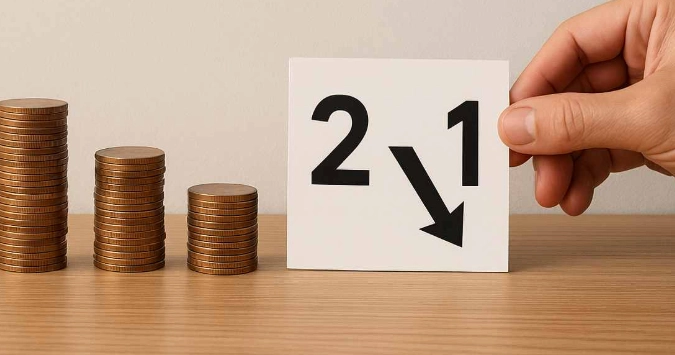
Meeting Exchange Listing Requirements
This is the most common and publicly stated reason. Major exchanges like the NYSE and NASDAQ have minimum bid price requirements (usually $1). If a stock trades below that threshold for a sustained period (30 consecutive trading days on the NASDAQ, for example), the company gets a delisting warning. A reverse split is the fastest way to mechanically boost the share price above the requirement. It's a stay of execution, not a pardon.
Improving Perception and Attracting Institutional Investors
Many institutional funds, mutual funds, and even some analysts have internal rules against owning stocks below a certain price, often $5 or $10. A $0.50 stock is seen as speculative, risky, and "un-investable" to this crowd. By reverse splitting into the $5-$20 range, management hopes to shed the "penny stock" stigma and appear on the radar of more serious investors. Does it work? Sometimes. But savvy institutions look at the fundamentals, not just the price tag.
A Component of a Larger Turnaround Plan
In rare, better-case scenarios, a reverse split is one piece of a broader restructuring. A company that has sold off unprofitable divisions, paid down debt, and has a clear new strategy might use a reverse split to clean up its capital structure as a symbolic fresh start. The key is the "larger plan." The split alone does nothing.
The Ugly Truth: A Last Resort for Failing Companies
Let's not sugarcoat it. Often, a reverse split, especially a drastic one, is a sign of a company in deep distress. It's out of options. The stock price has collapsed due to poor performance, massive debt, or lost market share. The reverse split is a cosmetic attempt to hide the symptoms (low price) without curing the disease (bad business). I've seen this story end in bankruptcy more times than I've seen it lead to a glorious recovery.
Case Study: Citigroup's 1-for-10 Reverse Split
Let's look at a famous, large-scale example. In 2011, Citigroup (C), still reeling from the 2008 financial crisis, executed a 1-for-10 reverse stock split.
Pre-Split Situation: Citi's stock was trading around $4.50. While above the $1 delisting threshold, the management, led by then-CEO Vikram Pandit, argued the low price attracted the wrong kind of short-term, speculative trading and failed to reflect the bank's "true" value post-bailout and restructuring.
The Action: On May 6, 2011, every 10 shares of Citi became 1 share. The stock opened that day at roughly $45 (10 x $4.50).
The Aftermath (The First Few Years): It was a disaster for the narrative. The stock didn't hold $45. It drifted lower, underperforming peers like JPMorgan Chase. By late 2011, it was back in the $20s. The split did nothing to improve the fundamental challenges Citi faced—regulatory scrutiny, legacy assets, and a sluggish global economy. For years, it was a textbook case of a reverse split failing to instill confidence.
The Long View: Here's where it gets interesting. Fast forward a decade. By the early 2020s, Citi had undergone significant further restructuring. The reverse split was a forgotten footnote. The stock's performance was then driven by interest rates, credit quality, and management's execution—the actual business fundamentals. The split itself was neither good nor bad in the long run; it was irrelevant. The business's health was all that mattered.
This case teaches us that a reverse split from a blue-chip name doesn't guarantee a turnaround. The market sees through the cosmetic change if the fundamentals don't follow.
How a Reverse Split Affects Share Price and Your Investment
Let's break down the mechanical and market effects.
| Aspect | Mechanical Effect (Guaranteed) | Market Effect (Not Guaranteed) |
|---|---|---|
| Share Price | Increases proportionally to the split ratio. | Often continues its prior trend. A "pop" is usually short-lived. |
| Number of Shares You Own | Decreases proportionally. 100 shares become 10 after a 1-for-10. | No change. This is a fixed mathematical adjustment. |
| Total Value of Your Holding | Remains exactly the same on the effective date. | Will change based on how the market prices the stock post-split. |
| Liquidity & Trading | Fewer shares outstanding can mean wider bid-ask spreads. | Often reduces trading volume initially, which can increase volatility. |
| Dividends (if any) | Per-share dividend is adjusted upward proportionally. | The total dividend payout by the company remains the same. |
The market effect is the wild card. Academics will tell you it's a neutral event in an efficient market. In reality, it's a signaling event. The market interprets the signal based on context. Is this a growing tech company fixing a listing issue, or a zombie company with no profits? The reaction will be wildly different.
The Psychological and Market Perception Game
This is where things get behavioral. Humans are terrible at thinking in percentages but decent at thinking in absolute prices. A stock jumping from $1 to $10 feels like a huge gain, even though the investor's stake didn't change. Management banks on this psychology.
They hope the higher price will:
- Reduce Short-Seller Attention: Shorting a $1 stock is very different from shorting a $10 stock in terms of risk and capital required.
- Create a "Quality" Illusion: Unconsciously, many associate a higher share price with a more stable, mature company. It's a cognitive bias, but a powerful one.
- Simplify Storytelling: It's harder for a CEO to talk about a "bright future" when the stock chart looks like a flatline near zero. A higher price point provides a cleaner slate for the narrative.
But the market isn't stupid for long. If the higher price isn't supported by fundamentals—revenue, earnings, cash flow—it will crumble. The psychological boost is temporary.
Strategic Considerations for Investors
So, you get the announcement. What now? Don't just sit there. Have a process.
First, Diagnose the "Why." Read the company's press release and SEC filing (usually an 8-K). Are they explicit about avoiding delisting? Is it part of a broader strategic update? The language matters. Vague optimism is a red flag. A clear plan tied to specific financial targets is slightly better.
Second, Ignore the New Price. Seriously, try to forget it. Your analysis should pretend the split didn't happen. Look at the company's market cap, price-to-sales ratio, debt-to-equity ratio—metrics that are unaffected by the share count change. Is the business, at its core, getting better or worse?
Third, Assess Management's Track Record. Has this management team delivered on promises before? Or is this the same team that drove the stock into the ground in the first place? A reverse split from a proven, trustworthy leader in a tough industry carries more weight than one from a serial underperformer.
Fourth, Watch the Technicals Post-Split. Does the new price find support, or does it immediately roll over? Heavy selling volume in the weeks after the split is a very bad sign. It means the smart money is using the slight liquidity bump to exit.
Fifth, Re-evaluate Your Thesis. Why did you buy this stock initially? Has that thesis been broken? The reverse split is a forcing event to re-do your homework. If the original reason for owning it is gone, the split is an irrelevant detail. Time to sell.
Common Pitfalls and Misconceptions
Pitfall #1: "The stock is cheaper now!" after a post-split drop. This is anchoring bias. If a stock goes from $10 (post-split) to $8, it feels like a bargain compared to $10. But you must compare it to the pre-split equivalent of $0.80. Has the business improved enough to justify $0.80 becoming $8? Probably not.
Pitfall #2: Assuming institutional buying will follow. Institutions have research teams. They won't buy just because the price is higher. They need to see a compelling fundamental story first. The split might get it on a screening report, but that's it.
Pitfall #3: Thinking options are a safe play. As noted in the FAQ, options are adjusted in complex ways. Liquidity often evaporates. What was a liquid $5 call becomes an illiquid $50 call. Trading these post-split contracts is for experts only.
Misconception: A reverse split changes the company's debt or assets. It does not. The balance sheet is untouched. No debt is magically repaid. No new factories are built.
Misconception: It's always a prelude to bankruptcy. Not always. While the odds are against a dramatic recovery, some companies do use it as a stepping stone. The difference is what else is happening concurrently.
Your Questions Answered
If a company I own does a reverse split, should I sell immediately?
What is the biggest mistake investors make after a reverse split?
Can a reverse split ever be a genuinely positive long-term sign?
How does a reverse split affect options contracts I hold?
The bottom line on reverse splits is this: treat them as a bright, flashing warning light on your dashboard. It tells you to pull over and check the engine. Sometimes it's just a loose gas cap (a minor technical issue). Other times, it's smoke pouring from the hood (a fundamental breakdown). Your job is to open the hood and look. Don't just drive on hoping the light will turn off by itself.
Reader Comments