Let's talk about the economy. It's not just a section of the news you skip. It's the reason your grocery bill feels heavier, why your friend just got a raise, or why that new apartment is suddenly out of reach. At its core, the economy is the vast, interconnected system of how a society produces, distributes, and consumes goods and services. Think of it as the ultimate team project for everyone in a country or region, where we all play a part—by working, spending, saving, or investing.
Most definitions stop there. They'll give you the textbook line: "the management of scarce resources." That's true, but it's bloodless. It misses the human chaos. The economy is really about choices and consequences. Your choice to buy a coffee fuels a chain that stretches from a Brazilian farmer to your local barista's paycheck. A government's choice to raise interest rates might mean your car loan gets more expensive next year.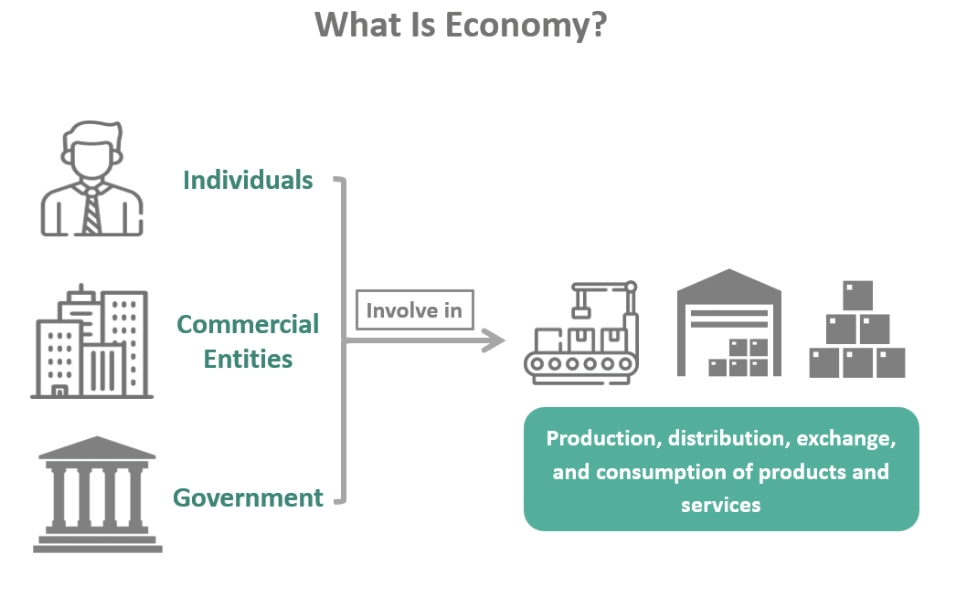
I've spent over a decade analyzing these chains and consequences. The biggest mistake I see? People think the economy is an abstract force, like the weather, that they can't understand or influence. That disconnect is costly. Understanding the basic machinery gives you a map in a confusing world. It helps you make better decisions about your career, your investments, and your family budget.
What You'll Learn
How Does the Economy Actually Work? The Three Core Activities
Strip away the complexity, and you find three fundamental activities that make the economic engine turn: production, distribution, and consumption. They form a continuous loop.
Production is the starting point. This is where businesses, factories, farms, and service providers create the things we need and want. A software company writing code, a factory assembling smartphones, a farmer growing wheat—they're all engaged in production. The resources they use—labor, capital (machines, offices), land, and entrepreneurship—are called the factors of production.
Here's a subtle point beginners miss. Production isn't just about physical stuff. In modern economies like the US, services—healthcare, education, haircuts, legal advice—make up the vast majority of economic output. The Bureau of Economic Analysis (BEA) data shows services account for over 75% of US GDP. Ignoring the service sector means you're only seeing a quarter of the picture.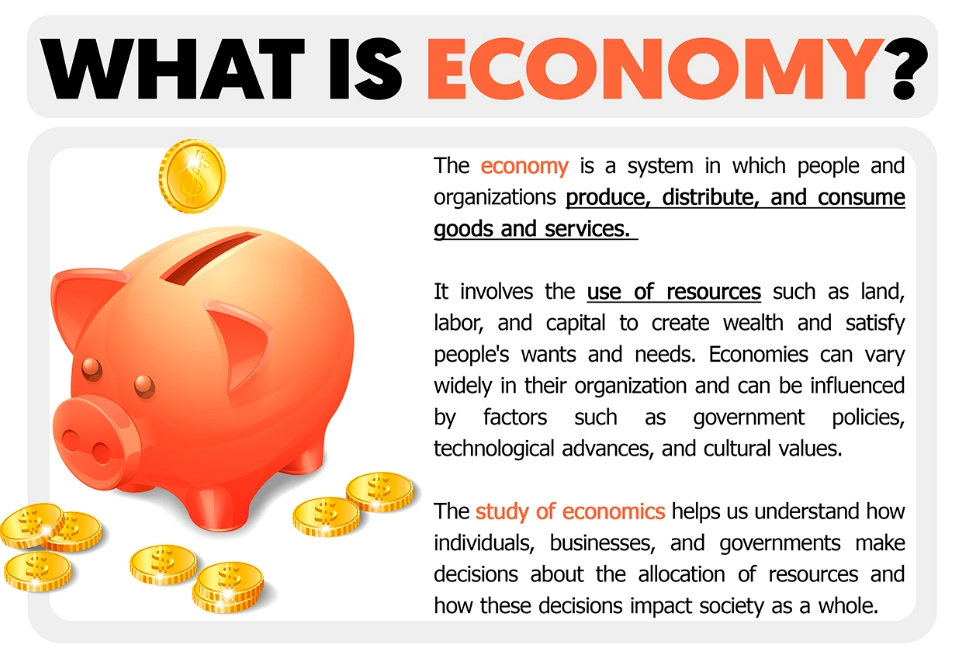
Distribution is how those goods and services get from producers to you. This is the supply chain, the logistics network, the retail stores, and the digital marketplaces like Amazon. When this system gets gummed up—as we saw during the pandemic with container ships stuck at ports—prices rise and shelves go empty. Distribution is the economy's circulatory system.
Consumption is the final, crucial act. This is you and me buying groceries, paying rent, subscribing to Netflix, or getting a haircut. Consumer spending is typically the largest single component of economic activity in major economies. When consumers feel confident and spend, businesses thrive and hire. When they pull back, the whole system can slow down.
The Human Loop: Imagine a local coffee shop. The production is the barista making your latte (combining labor, capital [espresso machine], and materials [coffee beans]). The distribution was the roaster selling beans to the shop and the shop being in a location you can reach. Your consumption is buying the latte. The money you spend pays the barista's salary (enabling their consumption elsewhere) and buys more beans, keeping the loop going. That's the economy in a (coffee) cup.
How Do We Measure This Thing? Key Economic Indicators Explained
We can't manage what we don't measure. Economists and policymakers use a dashboard of indicators to gauge the economy's health. Relying on just one is like diagnosing your health only by checking your weight. You need a fuller picture.
| Indicator | What It Measures | Why It Matters to You | Key Source (U.S.) |
|---|---|---|---|
| Gross Domestic Product (GDP) | The total monetary value of all finished goods and services produced within a country's borders in a specific time. | The broadest scorecard for economic size and growth. Rising GDP usually means more jobs and opportunity. | Bureau of Economic Analysis (BEA) |
| Consumer Price Index (CPI) | The average change over time in prices paid by urban consumers for a market basket of consumer goods and services. | This is inflation. It directly measures your cost of living. When CPI rises, your money buys less. | Bureau of Labor Statistics (BLS) |
| Unemployment Rate | The percentage of the labor force that is jobless and actively seeking employment. | Measures job market health. High rates mean economic distress and less consumer spending power. | Bureau of Labor Statistics (BLS) |
| Consumer Confidence Index | A survey-based gauge of how optimistic or pessimistic consumers are about their financial future and the economy. | A leading indicator. If confidence drops, people spend less, which can slow the economy ahead of hard data showing it. | The Conference Board |
My non-consensus take? People obsess over GDP growth rates, but for the average person, the CPI and wage growth data are more immediately relevant. If GDP grows at 3% but inflation (CPI) is at 4% and your wages are flat, you're effectively getting poorer, regardless of the headline GDP number. Always cross-reference the indicators.
The Central Bank's Levers: Interest Rates
This is where theory meets your wallet. Institutions like the Federal Reserve (the Fed) in the US use interest rates as their primary tool to manage the economy. Here's the simplified playbook:
- Economy overheating, inflation high? The Fed raises interest rates. This makes borrowing more expensive for businesses and individuals (think mortgages, car loans). The goal is to cool down spending and investment, slowing the economy to curb inflation.
- Economy in a slump, unemployment high? The Fed lowers interest rates. This makes borrowing cheaper, hoping to stimulate spending on big items (houses, cars) and business expansion, which creates jobs.
The lag between a rate change and its effect on the broader economy is 6-18 months. That's why central banking is often called an art, not a science.
The Economy Isn't Abstract: How It Hits Your Wallet Right Now
Let's get concrete. You're not just reading about concepts; you're living them. Here are three direct channels.
1. The Job Market Pulse. The economy's strength dictates hiring, layoffs, and wage pressures. In a booming economy with low unemployment, employers compete for workers. You might see more job openings, higher starting salaries, and better benefits. In a recession, the opposite happens. Opportunities dry up, and job security plummets. The sectors that thrive also shift—tech might boom in one cycle and contract in another, while healthcare often remains stable.
2. The Price Tag on Everything (Inflation). This is the most visceral impact. When the economy's demand outpaces its ability to supply goods and services, prices rise. It's not just gas and groceries. It's rent, home prices, used cars, and restaurant meals. Your savings lose purchasing power if they're sitting in a low-interest account not keeping pace with inflation. This is why understanding inflation is a survival skill.
3. The Cost of Money (Interest Rates). As mentioned, the Fed's moves directly affect your debt and savings. A high-rate environment means:
- More expensive debt: Credit card APRs, mortgage rates, and auto loan rates climb.
- Better returns on savings: High-yield savings accounts and CDs finally pay something meaningful.
A low-rate environment means the opposite: cheap debt but pitiful returns on safe savings. Your financial strategy must adapt to this backdrop.
Navigating the Economic Waves: Practical Steps for Individuals
You can't control the economic tide, but you can learn to sail better. Here's what a decade of watching cycles has taught me.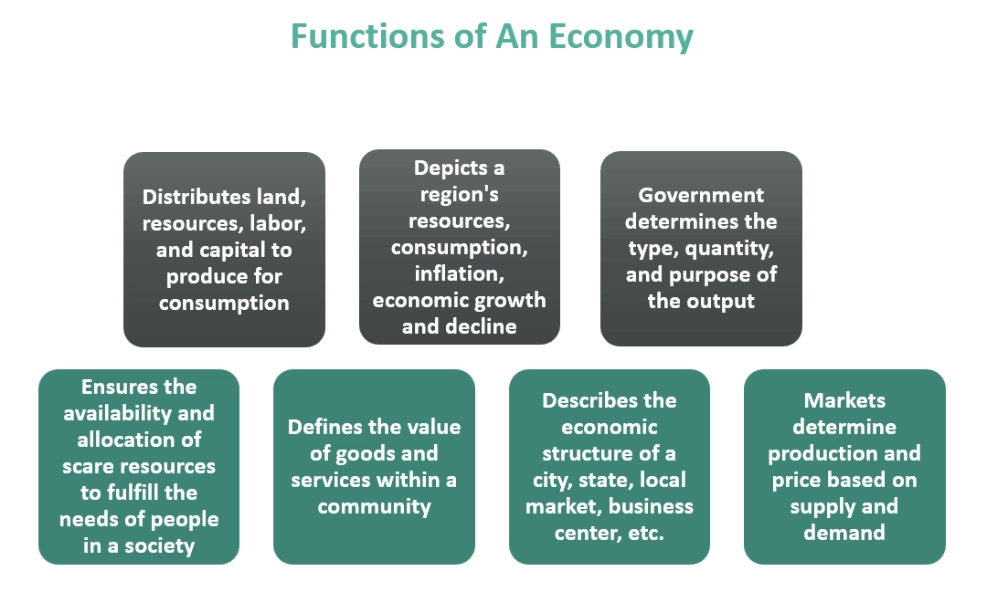
Build a Shock-Absorbent Budget. This is non-negotiable. Track your income and expenses. Know where your money goes. Then, prioritize building an emergency fund that covers 3-6 months of essential expenses. This cash buffer is your primary defense against a job loss or unexpected bill, regardless of what the GDP does.
Debt Strategy is Economic Strategy. In a rising interest rate environment, prioritize paying down high-interest, variable-rate debt (like credit cards). Lock in fixed rates on necessary debt (like a mortgage) when rates are favorable. I've seen too many people get crushed because they took on massive variable-rate debt just before a rate-hiking cycle.
Invest with a Long-Term Lens. The stock market is not the economy, but it's correlated. Trying to time the market based on economic headlines is a fool's errand for most. Instead, focus on consistent, long-term investing in diversified assets (like low-cost index funds). Automate contributions. This discipline smooths out the economic bumps over decades.
Invest in Your Most Valuable Asset: You. Your skills and adaptability are your best hedge against economic change. Continuous learning, networking, and developing in-demand skills make you more resilient, whether the economy favors tech, green energy, or healthcare next.
Your Burning Economy Questions, Answered
What's the one economic indicator I should watch most closely as a regular person?
If inflation stays high, what's the biggest mistake people make with their savings?
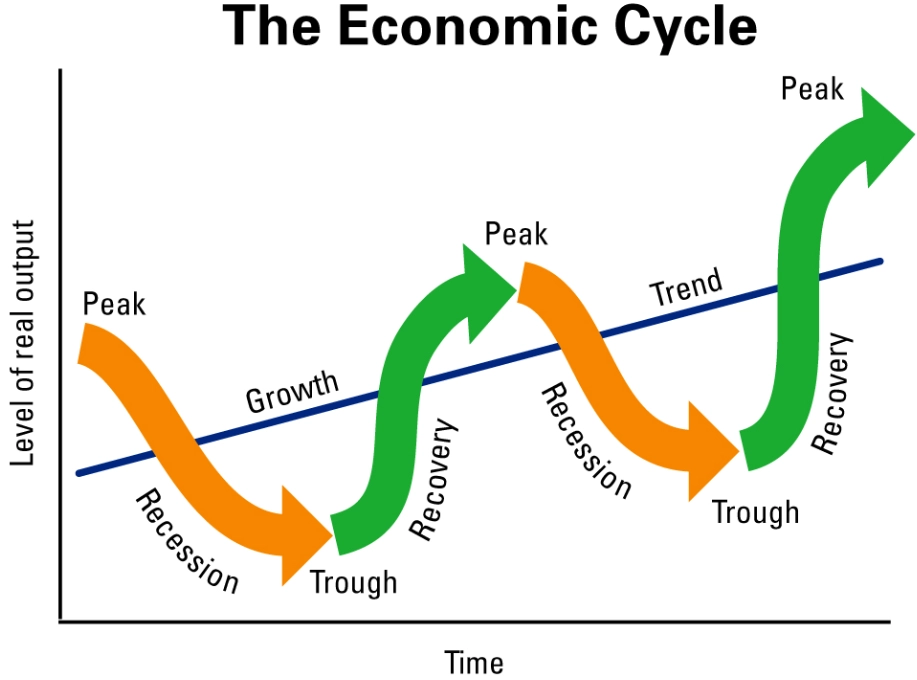 Everyone talks about a "recession." How will I actually feel it, and what should I do first?
Is the move to a "gig economy" good or bad for the overall economy?
Reader Comments