Let's cut to the chase. Modern Monetary Theory (MMT) isn't a magic trick for printing free money, despite what its loudest critics claim. Having followed economic policy debates for over a decade, I've seen MMT shift from a fringe academic idea to a central talking point in discussions about pandemic stimulus, infrastructure bills, and soaring national debts. For investors, ignoring it is a mistake. At its core, MMT provides a different lens for understanding how government spending, taxes, and inflation interact—a lens that becomes crucial when you're trying to protect and grow your wealth in today's policy environment. This guide strips away the political noise to give you the actionable insights you need.
In a Nutshell: Your Quick Guide
Understanding the Core Tenets of Modern Monetary Theory
Forget the textbook definitions for a second. Think of a country that issues its own currency, like the US, Japan, or the UK, as having a unique superpower. MMT starts with a simple, often overlooked accounting fact: such a government can never run out of its own money. It can always create more to pay its bills. This isn't an opinion; it's a technical reality of how the monetary system works, as detailed in analyses from institutions like the Federal Reserve.
The immediate reaction is usually, "But that will cause hyperinflation!" MMT proponents agree that reckless creation can cause inflation. But here's their crucial, non-consensus twist: taxes aren't primarily for funding spending. In the MMT view, taxes serve to create demand for the currency (you need dollars to pay the IRS) and, more importantly, to control inflation by taking money out of the economy. Government spending puts money in; taxation takes it out. The goal is to balance them at full employment.
This flips the traditional household analogy ("a government must balance its budget like a family") on its head. A currency-issuing government is not revenue-constrained. Its limit isn't dollars in the bank, but real resources in the economy. If the government spends too much when factories are at full capacity and everyone has a job, it will bid up prices—that's inflation. The constraint is inflation, not solvency.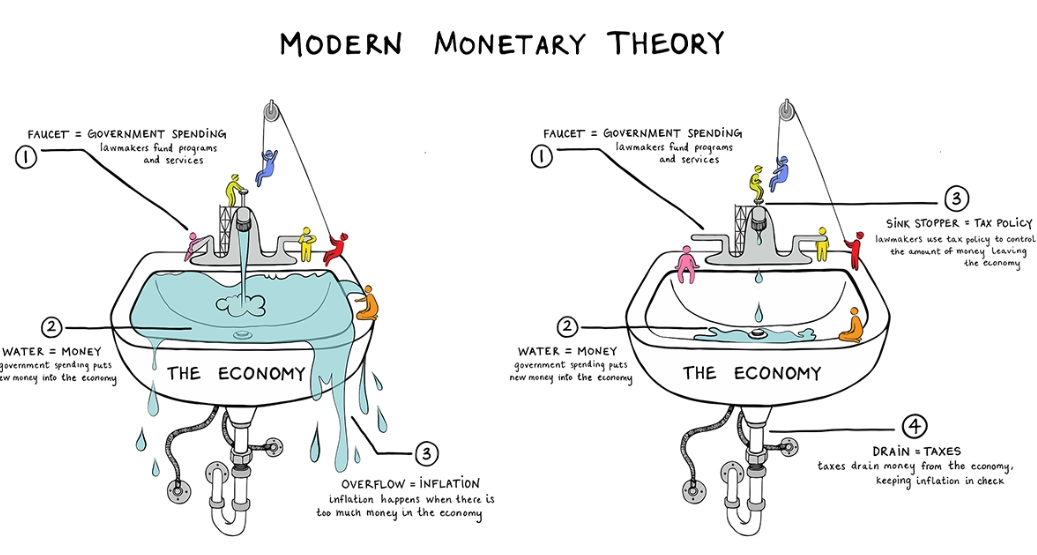
| Traditional View | MMT View |
|---|---|
| Government must fund spending via taxes or borrowing. | Government creates money to spend; taxes destroy money. |
| High government debt is a burden on future generations. | Government debt is non-government savings (in the form of Treasury bonds). |
| Full employment is a market outcome. | Full employment should be a policy goal, achieved via a Job Guarantee program. |
| The risk of overspending is default/bankruptcy. | The primary risk of overspending is inflation. |
Where many introductory articles stop is right here, with these principles. But as an investor, you need to know what this means when the rubber meets the road.
Modern Monetary Theory in Action: Case Studies and Real-World Scenarios
Let's look at where MMT thinking has visibly influenced policy or provides a compelling explanation for events.
The Pandemic Response: A Textbook MMT Moment?
The US government's response to COVID-19 was arguably the largest real-time experiment in MMT-like policy. Trillions were spent on stimulus checks, enhanced unemployment, and business loans. The Federal Reserve massively expanded its balance sheet to keep rates low. Crucially, this was done without the traditional political hand-wringing about "how to pay for it." The focus was squarely on the size of the need, not the dollar figure.
The result? Averted a depression, but also ignited inflation. An MMT analyst would say this proves their point: the constraint is real resources. When the government flooded the economy with money while lockdowns and supply chain issues crippled production (the real resources), inflation was the inevitable outcome. The policy mistake wasn't spending per se, but spending without adequate measures to boost the economy's productive capacity in the short term.
Japan: The Living Laboratory
Japan has a debt-to-GDP ratio over 250%, the highest in the developed world. For decades, mainstream economists have predicted a bond market crisis and runaway inflation. It hasn't happened. Interest rates remain near zero, and inflation stayed stubbornly low for years.
MMT offers a clear explanation: Japan is a sovereign currency issuer with a large pool of domestic savings willing to hold its bonds. The debt is largely owned domestically. The real constraint—inflation—never bit because the economy suffered from chronic weak demand and underutilized resources. Japan could "afford" its debt because it was never truly insolvent, just facing different economic challenges. This case study directly challenges the fear-mongering around debt levels that often spooks markets.
A Hypothetical Scenario: The Green Energy Transition
Imagine a future administration declares a "Green New Deal" a national priority. The price tag is $10 trillion over a decade. The traditional debate drowns in questions of tax hikes and deficit horror stories.
An MMT-informed approach would ask different questions: Do we have the physical resources—steel, copper, engineers, construction workers—to undertake this without causing massive inflation in those sectors? If not, the policy response wouldn't be to abandon the plan or hike taxes first. It would be to first invest in building that capacity: training programs, subsidies for mining critical minerals, expanding university engineering departments. The spending on the actual transition would be phased in as capacity grows, with tax adjustments used as a fine-tuning tool to manage aggregate demand and prevent overheating.
This scenario shows how MMT shifts the debate from accounting to real economics.
The Investor's Playbook: Navigating an MMT-Influenced Economy
Okay, theory and case studies are fine. But what do you actually do with your money? If MMT logic continues to guide policy (meaning governments are less afraid to run large deficits for priorities), several investment implications follow.
Forget the bond market apocalypse narrative. The fear that US Treasury bonds will collapse under the weight of debt is a persistent theme in some financial circles. MMT suggests this is highly unlikely for a currency issuer like the US. The Fed can always ensure the government can finance itself. The risk isn't default; it's that the Fed might let rates rise to fight inflation, which would lower bond prices. Your focus should be on inflation expectations and Fed policy, not solvency scare stories.
Real assets become even more critical. If the long-term risk is currency devaluation via inflation rather than government default, owning things that hold real value is key. This isn't just about gold. It's about:
- Productive equity in companies with pricing power that can pass on cost increases.
- Real estate in supply-constrained areas.
- Commodities and infrastructure that are essential to the economy.
Sector bets tied to policy priorities. An MMT-informed government spends where it sees public purpose. If the priority is climate, green tech and infrastructure companies could see sustained demand. If it's healthcare or chip manufacturing, those sectors get a tailwind. Your job is to identify the long-term political priorities, not just the quarterly earnings.
| Asset Class | Consideration in an MMT Policy Environment | Potential Action |
|---|---|---|
| Government Bonds | Default risk low; interest rate/inflation risk higher. | Focus on TIPS (inflation-protected securities), keep duration in check. |
| Stocks | Benefit from fiscal stimulus boosting demand; hurt by aggressive anti-inflation rate hikes. | Overweight sectors aligned with long-term fiscal priorities (infrastructure, green energy). Seek companies with strong pricing power. |
| Real Assets (Real Estate, Commodities) | Primary hedge against currency devaluation and inflation. | Maintain a core allocation. Consider REITs and commodity ETFs for liquidity. |
| Cash | Loses purchasing power if inflation runs above interest rates. | Don't park significant long-term capital here. Use for liquidity and short-term needs only. |
The subtle error many investors make is treating all large deficits the same. A deficit to fund tax cuts for asset owners might inflate financial markets. A deficit to build a nationwide broadband network might boost productivity and different sectors. The purpose of the spending matters as much as the size.
Common Misconceptions and Expert Insights
Let's clear the air on a few things.
"MMT says we can print money forever with no consequences." This is the biggest straw man. Every serious MMT economist, from Stephanie Kelton to Warren Mosler, stresses the inflation constraint. Their argument is that we should identify that constraint correctly and use policy tools (like targeted taxes or a Job Guarantee) to manage it, rather than using an arbitrary debt limit as a proxy.
"It will lead to Zimbabwe-style hyperinflation." Hyperinflation episodes are almost always tied to a collapse in the production side of the economy (war, political collapse) or a loss of faith in the currency itself, often because it's pegged to something else or the government is spending in a foreign currency it can't issue. For a politically stable issuer like the US spending in its own currency, the path to hyperinflation is far more complicated than just deficit spending.
"It ignores the crowding-out of private investment." MMT argues that in an economy with unemployed resources, government spending doesn't crowd out private investment; it creates the demand and income that makes private investment profitable. Crowding out only happens at full employment, which is exactly when MMT says fiscal policy should pull back.
My personal critique of MMT isn't about its core monetary analysis, which I find robust. It's about the political economy. The theory places enormous faith in the government's ability to wisely identify the "real resource limit" and adjust spending and taxes with surgical precision to hit full employment without overshooting. Having watched political cycles for years, I'm skeptical of that level of fine-tuning. Politics is messy and reactive. This is why investors must watch for the lag between stimulus, inflation, and the policy response—that's where volatility is born.
Your Burning Questions on MMT and Investing
Can MMT policies lead to uncontrollable inflation that destroys my savings?
The risk is mismanagement, not inevitability. MMT identifies inflation as the true limit. If a government spends far beyond the economy's capacity to produce goods and services, inflation follows. The safeguard, in the MMT framework, is a responsive fiscal policy—raising taxes to cool demand. The practical risk for investors is that this adjustment might be too slow due to political gridlock. That's why maintaining a hedge with real assets (stocks, property, commodities) is a prudent strategy regardless of the prevailing economic theory.
Does MMT mean the US dollar could lose its reserve currency status?
This is a more nuanced threat than often presented. MMT actually highlights the dollar's unique strength: its global demand allows the US more fiscal space. Losing reserve status wouldn't happen because of deficits alone. It would require a fundamental loss of trust in US political institutions, the rule of law, or the depth of its financial markets. While reckless policy could contribute, it's a geopolitical and institutional issue first. For now, there is no credible alternative with the same depth and stability.
 As a retail investor, what's the one thing I should change in my strategy if I believe MMT is influential?
Shift your mental model for government bonds. Stop viewing them as a "safe" asset because the government won't default. Start viewing their primary risk as interest rate risk driven by inflation and Fed reaction. This means diversifying your "safe" holdings. Consider allocating a portion of what you'd normally put in long-term bonds to shorter-duration bonds, TIPS, or even a small, disciplined allocation to gold ETFs as a non-correlated hedge. It's about redefining what safety means in a world of active fiscal and monetary policy.
How does MMT differ from standard Keynesian economics that also advocates for deficit spending in downturns?
The difference is in the plumbing and the priorities. Traditional Keynesianism sees deficits as a necessary evil to boost demand during a slump, with the goal of returning to a balanced budget later. MMT sees the currency-issuing government's budget as a permanent tool for achieving public purpose, with full employment as a continuous goal, not just a cyclical one. Operationally, Keynesians often think of the government as borrowing existing money to spend. MMT describes the spending as coming first, creating new money, with borrowing (bond issuance) functioning more as an interest rate maintenance tool for the central bank than a funding necessity. For investors, the key implication is that under an MMT influence, large deficits might become a more permanent feature of the landscape, not just a recession-time event.
Reader Comments