Quick Navigation
- Holding Company vs. Operating Company: What's the Actual Difference?
- The Big Question: Why Would You Bother Setting One Up?
- Let's Be Honest: The Downsides and Headaches
- How to Actually Set Up a Holding Company Structure
- Real-World Examples: From Simple to Complex
- Answers to Questions You're Probably Asking
- Final Thoughts: Is It Right For You?
You've probably heard the term thrown around in boardrooms, podcasts, or maybe in a conversation with your accountant. "You should consider a holding company structure." It sounds sophisticated, maybe a bit intimidating. Is it just for the big conglomerates like Berkshire Hathaway, or can it actually work for your growing business?
I remember sitting with a client a few years back, a guy who'd built a successful manufacturing business and was eyeing a commercial property. He wanted to buy the building his factory was in. His lawyer casually said, "We'll just have your holding company purchase it." My client looked at me, then back at the lawyer, and asked the million-dollar question: "What the heck is a holding company, and why do I need one?" That blank stare is more common than you think.
Let's cut through the jargon. A holding company doesn't really *do* anything in the traditional sense. It doesn't make products, serve customers, or run a marketing campaign. Its entire job is to own things. Specifically, it owns assets. The most common asset? Shares of other companies. Think of it as a parent whose sole purpose is to hold ownership of its children (the operating companies) and maybe some other valuable family heirlooms (real estate, intellectual property, investment portfolios).
The Core Idea: A pure holding company exists to control subsidiaries, manage assets, and mitigate risk. It's a strategic container, not an operational engine.
Holding Company vs. Operating Company: What's the Actual Difference?
This is where most of the confusion lies. People mix them up all the time. Let's lay it out side-by-side.
| Feature | Holding Company (The Parent) | Operating Company (The Subsidiary) |
|---|---|---|
| Primary Function | Owns assets & controls subsidiaries. Focuses on strategy, finance, and governance. | Runs day-to-day business operations. Makes products, provides services, deals with customers. |
| Revenue Source | Dividends from subsidiaries, management fees, asset sales, investment income. | Sales of goods/services to customers. |
| Liability Exposure | Generally limited to its own assets. Shielded from subsidiary's operational lawsuits. | Exposed to operational risks (lawsuits, debts, employee issues). |
| Employees & Operations | Minimal staff (CEO, CFO, legal). No core operations. | Full staff, manufacturing, sales teams, customer service. |
| Best For | Asset protection, multi-business portfolio management, tax planning, centralized control. | Actually running a business and interacting with the market. |
See the separation? In a well-structured setup, if your restaurant subsidiary gets sued for a slip-and-fall accident, the lawsuit (in theory) should be contained within that operating company. The plaintiff can't easily go after the real estate or the catering business owned by the parent holding company. That's the liability firewall everyone talks about.
But here's a personal opinion—that firewall isn't impenetrable. Courts can "pierce the corporate veil" if they find fraud, commingling of funds, or if the subsidiary is just a sham. Simply having a holding company structure isn't a magic shield if you treat all the company bank accounts as your personal piggy bank. I've seen it happen, and it gets ugly.
The Big Question: Why Would You Bother Setting One Up?
The benefits are compelling, but they're not automatic. You have to structure things correctly and follow the rules. Here’s where a holding company can shine.
Liability Protection (The #1 Reason)
We touched on this. It's about ring-fencing risk. Let's say you own a tech startup (risky) and a paid-off warehouse (valuable). If you run both under one company, a lawsuit against the startup could put the warehouse at risk. By placing the startup and the warehouse in separate subsidiaries under one holding company, you create compartments. A disaster in one compartment *hopefully* doesn't sink the whole ship.
Tax Efficiencies and Flexibility
This is complex and absolutely requires a pro. But in certain situations, a holding company structure can be a tax-smart move.
- Consolidated Returns: In the U.S., an affiliated group (a parent and its 80%+ owned subsidiaries) can often file a consolidated tax return. This lets you offset profits in one subsidiary with losses in another. A life-saver for a startup burning cash while another business is profitable.
- Dividend Management: Inter-company dividends can sometimes be received tax-free, allowing for efficient cash movement.
- Estate & Succession Planning: Transferring ownership shares of a single holding company can be cleaner than transferring shares of multiple operating businesses when planning for the future.
Tax Warning: The tax rules are a minefield. What works in one country or state can be a disaster in another. The "check-the-box" election with the IRS, for example, is a classic tool here. Never implement a holding company structure for tax reasons without a top-notch CPA and tax attorney. I've seen more people get this wrong than right on their first try.
Operational and Strategic Control
It centralizes control. The holding company's board makes the big calls: major investments, CEO appointments for subsidiaries, selling a business unit. The operating companies focus on execution. It also makes it easier to buy, sell, or spin off a business line. You're just selling the shares of that subsidiary, which can be cleaner than selling hard-to-untangle assets.
Easier Financing and Credibility
A holding company can raise capital at the parent level, based on the combined strength of its portfolio, and then downstream the funds to the subsidiary that needs it. It can also present a more professional, organized face to banks and investors.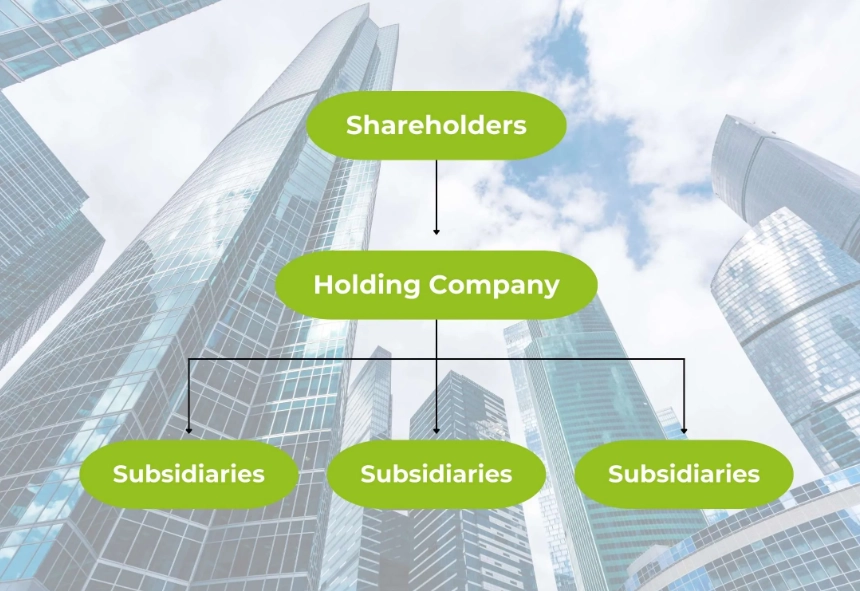
Let's Be Honest: The Downsides and Headaches
Nobody talks about these enough. It's not all rainbows.
Increased Complexity and Cost: This isn't a DIY project. You're creating multiple legal entities. That means multiple sets of formation documents, multiple annual reports, multiple tax filings (even if consolidated, the prep is complex), multiple registered agents. Accounting fees can double or triple overnight. You need separate bank accounts, separate bookkeeping for each entity. The administrative burden is real.
The Corporate Formality Trap: To maintain that liability shield, you must treat each company as legitimately separate. Separate meetings, separate minutes, separate resolutions. You can't pay the restaurant's lettuce supplier from the real estate company's account. The paperwork is relentless, and if you get sloppy, you risk losing all the protection you paid for.
It Might Be Overkill: For a single, small business with simple assets, a holding company is often unnecessary complexity. The costs can outweigh the benefits. If your main asset is your expertise and a laptop, focus on growing your business first.
How to Actually Set Up a Holding Company Structure
If you've weighed the pros and cons and it makes sense, here's a rough roadmap. Please, please use this as a conversation starter with your legal and financial team, not as a manual.
Step 1: Choose Your Jurisdiction and Entity Type
Where will you form the parent holding company? Delaware (U.S.) is famous for its business-friendly courts and laws. Wyoming and Nevada are popular for privacy and tax reasons. Your home state might be fine too. The entity is usually a corporation (Inc.) or an LLC. An LLC taxed as an S-Corp or C-Corp is a common choice for flexibility. This is decision #1 for your lawyer.
Step 2: Form the Holding Company
File the Articles of Incorporation/Organization for your new parent company. Get an EIN from the IRS. Open a dedicated bank account. This entity starts with no operations.
Step 3: Form or Reorganize Your Operating Subsidiaries
You'll create new LLCs or corporations for each business line or asset group (e.g., "ABC Tech LLC," "XYZ Real Estate LLC"). The critical part: the holding company must own 100% (or at least a controlling interest) in these subsidiaries. This is often done by the holding company being the sole member of an LLC or the sole shareholder of a corporation.
Step 4: The Capital Contribution & Transfer
This is the tricky financial/legal part. You need to legally transfer the ownership of the existing business assets into the new subsidiaries. If you have an existing business, this might involve selling or contributing its assets to a new subsidiary in exchange for that subsidiary's shares, which are then owned by the holding company. This step has tax implications. Do not skip professional guidance here.
Step 5: Implement Operational Agreements
Draft all the governing docs: Bylaws, Operating Agreements, Shareholder Agreements. Draft service agreements between the holding company and subsidiaries (e.g., a Management Services Agreement where the parent charges a fee for admin, HR, and legal support). This formalizes the relationships and cash flows.
And then you maintain it. Forever.
Real-World Examples: From Simple to Complex
Let's make it concrete.
The Local Entrepreneur: Sarah owns a successful bakery and just bought the building next door to expand. She creates "Sarah's Holdings LLC." Sarah's Holdings then owns 100% of "Sweet Treats Bakery LLC" (the operating business) and 100% of "Main Street Property LLC" (which owns the building). The bakery pays fair-market rent to the property LLC. If a customer slips in the bakery, the lawsuit targets Sweet Treats LLC, not the building asset in Main Street Property LLC.
The Tech Portfolio: A venture capital firm or an angel investor creates a holding company to hold their various startup investments. It's clean, centralized, and simplifies their own cap table.
The Conglomerate (Berkshire Hathaway): The classic example. Berkshire Hathaway is a massive holding company that owns Geico, Dairy Queen, BNSF Railway, and scores of others. It doesn't run them; it provides capital and high-level oversight while the subsidiaries operate independently.
Answers to Questions You're Probably Asking
Final Thoughts: Is It Right For You?
Look, a holding company is a tool. A powerful, sometimes essential tool for managing complexity, risk, and growth. But it's not a status symbol. It's not a quick fix for a failing business.
Ask yourself: Do I have multiple distinct business lines or valuable passive assets? Is my business generating enough profit to justify the extra legal and accounting costs? Am I prepared to be meticulous about corporate formalities?
If you're just starting out, keep it simple. Focus on finding product-market fit and generating revenue. The time for a holding company structure usually comes when you have something valuable to protect and a vision that involves more than one moving part.
The decision to form a holding company is a strategic one that sits at the intersection of law, finance, and business strategy. It requires good advice. Consult with a corporate attorney who has done this before and a CPA who understands multi-entity taxation. The Securities and Exchange Commission (SEC) also has resources on corporate structures for publicly traded entities, which can be insightful for understanding governance at scale, available on their CF Corporate Finance Guidance page.
It can be the architectural foundation for an empire. Or it can be an expensive and unnecessary maze. The difference lies in your specific circumstances and the quality of your execution.
Reader Comments